Wolf Oven Repair
Wolf Oven Door Not Closing: Hinge, Seal and Latch Checks
A Wolf oven door that will not close is usually blocked by a rack or pan, held open by a worn or unseated hinge, or pushed out by a damaged gasket. Here is how to test each one, what you can fix yourself and what the repair typically costs.
Written by
Thandiwe Mokoena
Cooking-appliance technician — convection and airflow · 16 years in the trade
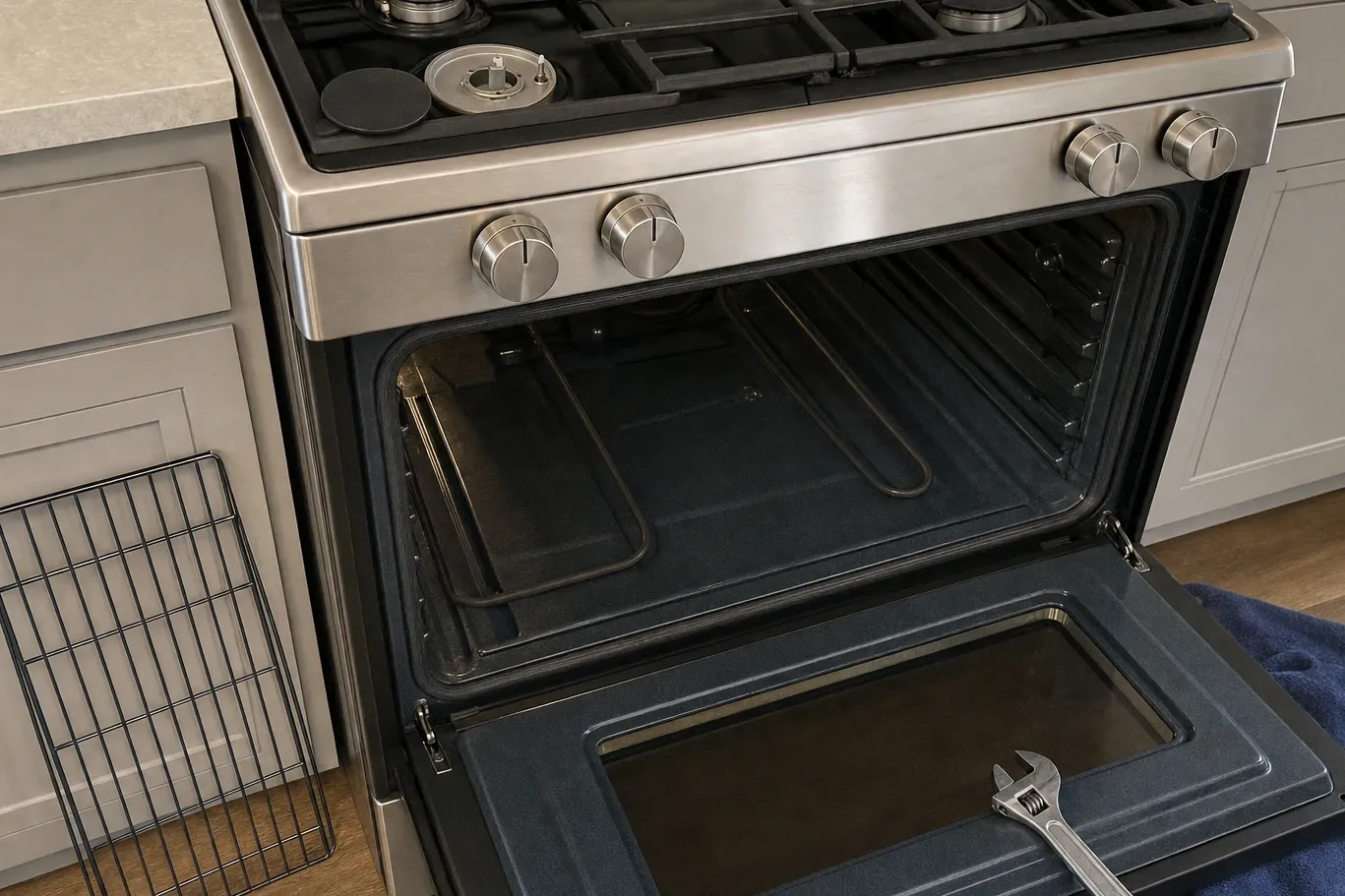
If your Wolf oven door is not closing, check the easy causes first: a rack pulled forward on one side, a pan or a sheet of foil sitting in the way, or a hinge that never dropped fully back into its slot after the door was last lifted off. When none of those is the answer, the culprit is almost always one of three parts — a worn or broken hinge, a torn or displaced door gasket, or the motorized latch after an interrupted Clean cycle. Even a small gap matters. Heat escapes, the oven works longer to hold its setpoint, and in a Phoenix kitchen in July that wasted heat lands in a room your air conditioning is already straining to keep livable.
Start with whatever is in the way
Open the door all the way and look before you assume anything is broken. Every rack should slide fully back on its guides; a rack resting on the wrong rung or skewed on one side will catch the inner door glass and stop the door a finger’s width short. Check the bottom lip of the oven frame for burnt-on crumbs, which can hold the door off its seal on that edge only.
Look at the oven floor too. Wolf asks owners not to set cookware directly on the floor and not to line the floor or side walls with aluminum foil, because both damage the porcelain interior and void the warranty. Loose foil has a second fault: it creeps forward as the oven heats and ends up folded against the door opening.
Test the seal and the alignment yourself
These checks take about ten minutes and need nothing more than a sheet of paper and a flashlight. Do them with the oven off and cold.
- Look from the side. Close the door and crouch level with it. The door should sit flush with the frame, with an even gap along the top and the bottom. One corner standing proud almost always means a hinge problem.
- Run the paper test. Shut the door on a strip of paper at the top, at each side and along the bottom, then pull it out. You should feel firm drag every time. Wherever it slides out freely, the gasket is not making contact.
- Try the light test. In a darkened kitchen, set a lit flashlight inside the cavity aimed at the door edge and close the door. Any glow around the perimeter shows you exactly where the seal is open.
- Inspect the gasket without handling it. Look for tears, flattened stretches, sections pulled out of their channel or rubber that has gone hard and shiny.
- Feel the hinges. With the door half open, rock it gently at the handle. A little movement is normal; a clunk or obvious sideways play points to a worn hinge or a loose mounting in the frame.
The door gasket: look at it, do not scrub it
Many owners make a marginal seal worse by cleaning it. Wolf’s own guidance is not to clean the oven door gasket at all, since rubbing or moving it can compromise the seal. Wipe the glass and the porcelain around it, and leave the gasket as it is.
Once a gasket is torn, there is no fix short of replacement. Wolf treats a torn gasket as a part to be renewed and points owners to a service visit rather than a home repair. Tape, high-temperature glue and pushing a loose section back into its groove all fail quickly, and a seal that leaks during a Clean cycle can scorch the cabinetry around a built-in wall oven.
Hinges: the usual reason a door will not shut
A Wolf oven door is large and heavy, and each hinge carries a strong spring to balance it. That load is why hinges are the most common mechanical reason a door refuses to close. The signs are a door that drops open over the last few inches, one that will not stay shut on its own, a door that sits crooked, or one that rubs the frame on one side.
The causes are fairly predictable: a hinge that was not fully seated after the door came off for cleaning, a spring that has weakened or snapped, a hinge arm bent by someone leaning on the open door or resting a heavy roasting pan on it, or mounting screws that have worked loose in the oven frame.
| What you notice | Likely cause | Who should handle it |
|---|---|---|
| Light leaks at one corner only | Hinge out of its slot or a bent arm | You, if the door was just removed; otherwise a technician |
| Door falls open or will not stay shut | Weak or broken hinge spring | Technician |
| Gasket torn, flat or hanging loose | Worn door gasket | Technician, for replacement |
| Door stays locked after Clean | Latch waiting for the cavity to cool | Wait it out; call if it never releases |
| Loud, repeated clicking near the latch | Latch or relay fault | Breaker reset, then a technician |
When the latch is the problem, not the door
Wolf advises against switching an oven off in the middle of a Clean cycle, because damage can occur when the cycle does not finish. If you do cancel one, the door stays locked until the oven has cooled, and that can take an hour or more. A door that seems stuck right after cleaning often just needs patience.
Some clicking is also normal: control boards, relay boards and the motorized door latch all click as they work. If the clicking becomes loud or repetitive, Wolf’s suggested reset is to turn off the breaker for 30 seconds and then restore power. If the latch hook is sticking out while the door is open, the door can strike it and refuse to close; a power reset often lets the latch return home. When it does not, the latch motor or the switch that reports its position has failed.
What a door repair typically costs
You pay $89 for the visit itself, a flat charge that includes finding the fault, and if you go ahead with the fix that $89 comes off the final bill. Hinge, door glass or gasket work typically runs $280–$750, and you get the firm quote after diagnosis, before any part is ordered. If the latch fault traces back to the control board or touch panel, that repair usually falls in the $470–$890 range. Either way, a door problem on a sound oven is almost always worth repairing rather than replacing the whole appliance.
If the door now seals but the oven still bakes cold, the fault lies somewhere else, and our guide to a wall oven that reaches its setpoint but bakes cold walks through it. For hinge, seal and latch work in Arcadia, Biltmore, North Central Phoenix and Ahwatukee, see our Wolf oven repair service or call (602) 560-4488.
Follow-up questions
- Is it safe to keep cooking in a Wolf oven whose door will not shut fully?
- Short meals are usually fine, but it is a poor habit to keep. Heat pours out of the gap, the oven runs its elements longer to hold temperature, and the handle, knobs and cabinetry next to the door get hotter than they were designed for. Never run a Clean cycle on an oven whose door does not seal, because that mode drives the cavity far hotter than any baking setting.
- How do I reset a Wolf oven that clicks or will not unlock?
- Turn off the oven's circuit breaker for 30 seconds, then switch it back on. Wolf names this as the step to take when the oven clicks loudly or over and over, because relays, the electronic boards and the powered door lock all make clicking sounds as part of everyday operation. If the door is still locked after a canceled Clean cycle, wait until the cavity has cooled, which can take an hour or more.
- Can I replace a Wolf oven door hinge on my own?
- Reseating a hinge that slipped out of its slot is a reasonable owner job if two people lift the door, but swapping a hinge or spring is better left to a technician. The springs are under heavy load and can snap shut on fingers, and the new hinge has to be adjusted so the gasket presses evenly all the way around.
- Should I clean the rubber seal around my Wolf oven door?
- No. Wolf tells owners to leave the door gasket alone, because wiping, rubbing or shifting it can spoil the seal it is meant to make. Clean the porcelain and the door glass around it, and if the gasket itself is torn or hanging loose, have it replaced rather than glued or tucked back.